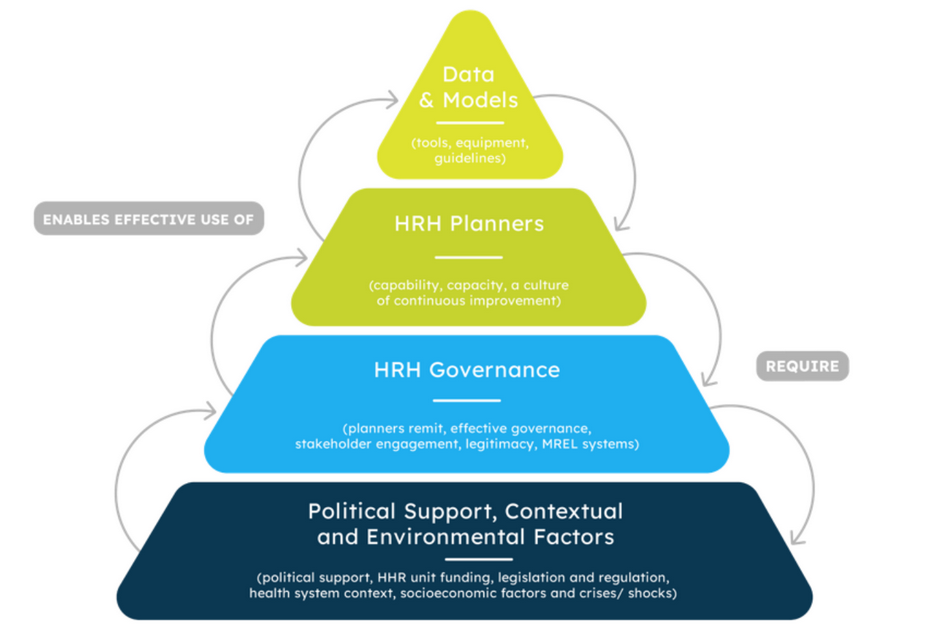
The HEROES Sustainability Framework emphasises that no single domain is sufficient on its own. Sustainable health workforce planning depends on the combined strength and interaction of political commitment, effective governance, skilled planners, and robust workforce intelligence systems. Weakness in any one domain limits the ability of countries to implement evidence-informed and resilient HWF planning over the long term. Therefore, “Data & models” domain evaluates the availability and quality of workforce data, forecasting models, and analytical infrastructure. It considers data interoperability, modelling capacity, workforce intelligence, and the ability to generate evidence that supports strategic planning and policy development. “Planners” focuses on the competencies required to carry out effective workforce planning. This includes technical, analytical, strategic, communication, and policy translation skills that enable planners to interpret evidence, develop forecasts, and support informed decision-making. “Governance” examines the governance arrangements that coordinate HWF planning, including institutional mandates, stakeholder engagement, leadership, intersectoral collaboration, and decision-making processes. Strong governance ensures that workforce planning becomes a permanent function rather than a project-based activity. Finally, the “Environment” assesses whether the political environment and health system context support long-term HWF planning. It considers political commitment, legislative backing, institutional positioning, and the alignment of workforce planning with broader health system priorities and reforms.